
Your Body in Space: A Comedy of Physiological Errors
Imagine waking up one morning to discover that your skeleton is on a silent, well-organized strike. Your muscles have decided to quietly quit. Your inner ear has filed a formal complaint with your brain, and your heart — having spent months convinced it lives on a planet with no gravity — is now utterly baffled by the concept of "standing up." Welcome to the post-spaceflight experience. Enjoy your stay on Earth. Try not to fall over.
Space is, objectively, one of the most extraordinary places a human being can travel. It is also, from a purely physiological standpoint, a comprehensive assault on nearly every system the human body has spent millions of years carefully optimizing. Bone density vanishes. Muscles atrophy. Vision blurs. The immune system gets confused. And dormant viruses, apparently sensing opportunity, decide to make a comeback tour. All of this happens while you're floating serenely, looking out a cupola window at the curvature of the Earth and thinking you've never felt better in your life.
This article explores what the science actually tells us about what happens to the human body during spaceflight, the extraordinary exercise regimens astronauts use to fight back, and what greets them and their thoroughly confused bodies upon return to Earth.
Everything Your Body Relied On Just… Disappeared
On Earth, every system in the human body has spent your entire life compensating for gravity. Your skeleton bears your weight. Your muscles fire constantly to keep you upright. Your heart pumps blood upward against gravitational resistance. Your inner ear uses the pull of the Earth to tell your brain which way is down. Remove gravity, even partially, and the body doesn't just relax. It reorganizes, and not in ways that are particularly useful for coming back.
1–1.5% Bone mass lost per month in space
~20% Reduction in dietary intake during flight
3–4 yrs Typical bone recovery time post-flight
~70% Of astronauts experience impaired balance post-landing
🦴 Bones: The Silent Resignation
Bone is living tissue, and it responds to mechanical loading — the constant compression and tension from bearing your body weight. Remove that loading, and the body concludes, not unreasonably, that it no longer needs so much bone. This is called disuse osteopenia, and in space it happens at a rate that would alarm any rheumatologist on Earth.
According to data compiled by NASA, the proximal femoral bone (upper thigh) loses 1% to 1.5% of its mass per month in microgravity, roughly 6% to 10% over a standard 6-month ISS mission. Research published in PMC/NIH found that spine bone density declined at 0.8–0.9% per month, while the hip showed even more striking losses in trabecular (spongy) bone. And perhaps most sobering: full recovery after a long-duration mission takes at least 3 to 4 years following return to Earth.
PubMed data from 18 cosmonauts on prolonged Mir space station missions confirmed that current in-flight exercise programs, while helpful, are not sufficient to completely halt bone loss during weightlessness. The bone, in other words, is making decisions the exercise equipment can soften but not fully override.
🌕
To put the bone loss rate in perspective: a 6-month ISS astronaut loses roughly the same amount of femoral bone mass as a person in their 70s loses over an entire decade. Space is, physiologically speaking, the world's most aggressive accelerated aging program. The views are better though.
💪 Muscles: The Great Atrophy
If bones are quietly resigning, muscles are actively staging a walkout. The anti-gravity muscles, the calves, thighs, lower back, and core that spend every waking moment on Earth maintaining posture and locomotion are suddenly unemployed. And like any workforce with no job to do, they begin to shrink.
A PubMed review describes spaceflight as causing "reductive remodeling of the musculoskeletal system," with protein lost from muscles that have anti-gravity functions. Research on paraspinal muscles found they declined at approximately 1.0% in cross-sectional area per month during spaceflight, accompanied by fatty infiltration, the muscle equivalent of replacing structural steel with foam packing peanuts.
Compounding this, a PubMed study noted that voluntary dietary intake is reduced during spaceflight by approximately 20%, limiting the body's ability to build or even maintain muscle protein. The body is simultaneously doing less mechanical work, eating less protein, and floating in an environment where the usual hormonal signals for muscle maintenance are altered. It's a perfect storm for atrophy.
🔬 NIH & NASA Joint Research: A NIAMS/NASA interagency workshop identified that fluid shifts and disrupted fluid balance also contribute to musculoskeletal changes in microgravity, beyond the simple "no loading" explanation. Some molecular and cellular events involved in loading and unloading of the musculoskeletal system are under neural and endocrine influence — meaning the hormonal environment of spaceflight adds another layer of complexity to muscle and bone loss.
❤️ Heart & Fluid Shifts: The Moon Face Chronicles
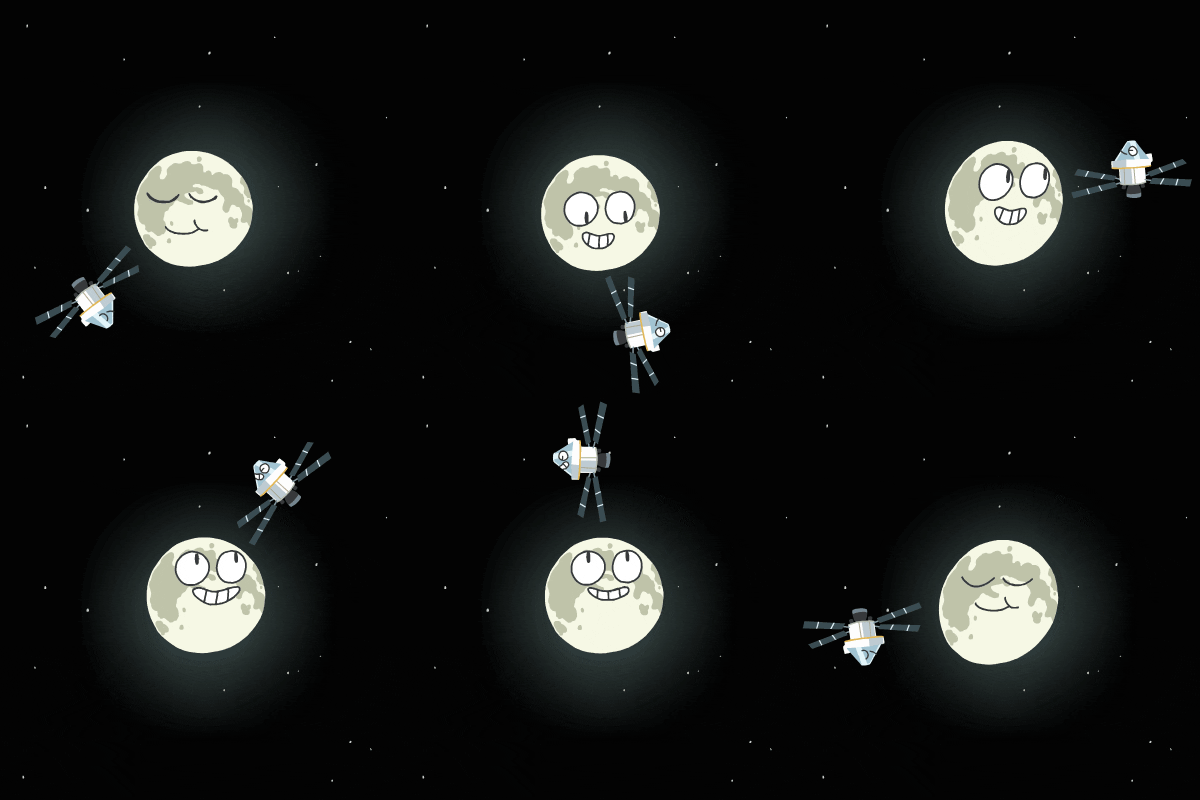
Within hours of entering orbit, astronauts notice something disconcerting: their faces begin to puff. Their legs thin out. They feel a persistent nasal congestion, as if they've been turned upside down which, metabolically, they effectively have.
On Earth, gravity pulls blood and fluid toward the lower body. In microgravity, that gradient disappears. Fluid shifts headward — toward the face, brain, and chest. NASA's Cardiovascular and Vision Laboratory research describes this as a headward fluid shift that mimics the supine posture on Earth, except that in space, the astronaut can never "stand up" to restore normal fluid distribution. This shift is unrelenting.
The cardiovascular system senses the relative increase in upper-body fluid and responds by reducing total blood volume, the opposite of what you'd want when returning to a gravity environment. Female astronauts have been found to be particularly susceptible to orthostatic intolerance (the inability to maintain blood pressure when standing) after landing.
😮 The characteristic puffed face seen in photos of astronauts in space is not a smile of pure wonder; it is approximately 2 liters of fluid that would normally be sitting in their legs, now redistributed northward. Astronauts have informally called it "bird legs and moon face." It sounds uncomfortable because it is.
👁️ Vision: When Space Literally Reshapes Your Eyes
One of the more alarming discoveries in modern space medicine is that extended spaceflight can cause structural changes to the eyes themselves. The condition now formally called Spaceflight-Associated Neuro-ocular Syndrome (SANS), formerly VIIP (Visual Impairment/Intracranial Pressure syndrome), affects a significant proportion of long-duration astronauts.
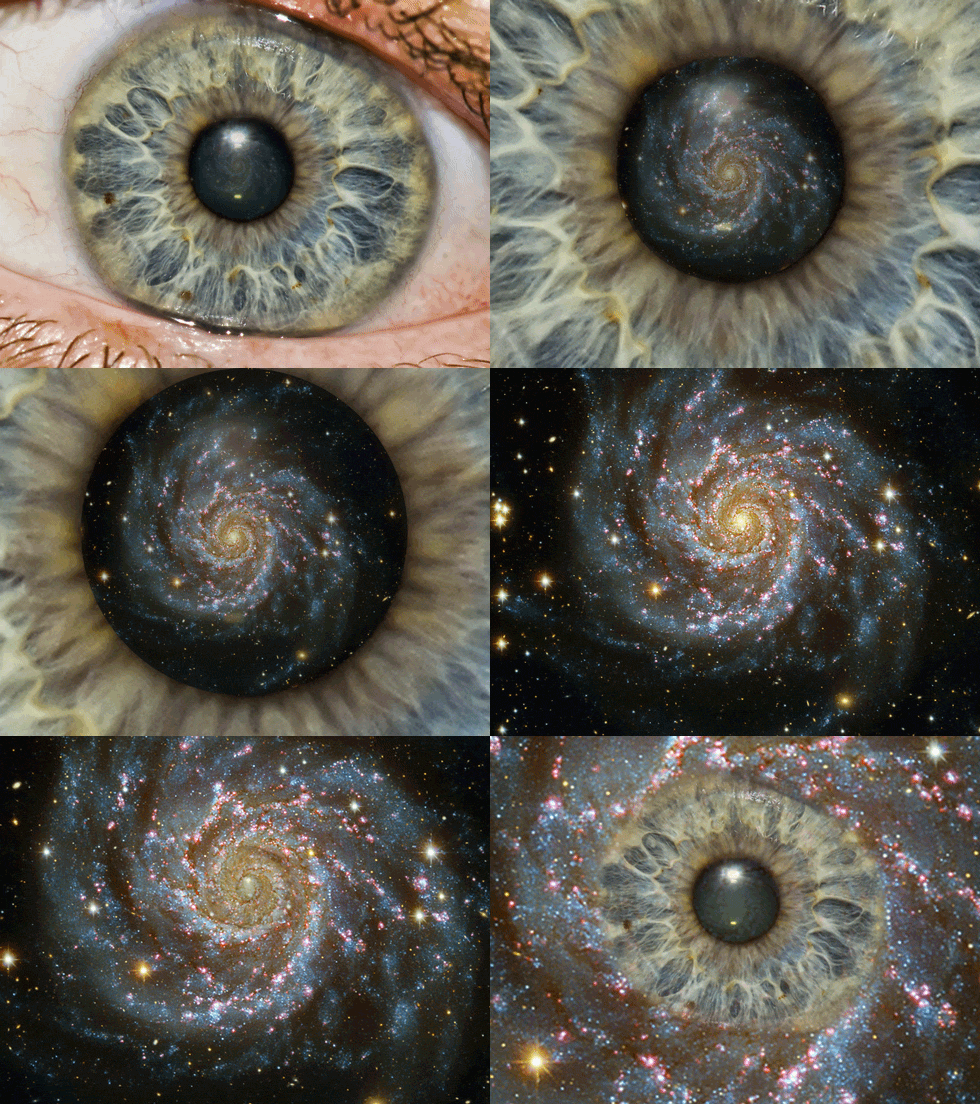
As described in the journal Physiological Reviews (PubMed), the headward fluid shift elevates cerebrospinal fluid pressure around the optic nerve. This leads to a cascade of structural changes: globe flattening (the eyeball becomes slightly less spherical), choroidal folding, optic disc edema, and optic nerve kinking. Some of these changes are not fully reversible upon return to Earth.
⚠️SANS is a current research priority for NASA. The agency has placed significant emphasis on understanding which astronauts are most at risk and why. Contributing factors under investigation include elevated cabin CO2 concentration, high-sodium diets, and genetic predisposition. Planning for future Moon and Mars missions depends heavily on resolving this issue, you can't land on Mars if your crew can't read the instruments.
🛡️ Immunity & Radiation: The Double Threat
Space is not content to attack only the structural systems. Research published in PubMed under the emerging field of astroimmunology confirms that spaceflight stressors, microgravity, galactic cosmic radiation, psychological stress, and disrupted circadian rhythms, collectively dysregulate the immune system in measurable ways.
Perhaps most striking: studies have found that latent viruses reactivate in astronauts during spaceflight, including herpes viruses responsible for cold sores and shingles. NASA's immune risk research page notes that dormant viruses may seize on the immune disruption caused by microgravity and radiation to make an unwelcome reappearance. Cytokine profiles shift, natural killer cell counts drop, and adaptive immune responses are altered. Changes that can persist for the duration of a 6-month mission.
Meanwhile, outside the protection of Earth's magnetic field and atmosphere, cosmic radiation poses a long-term cancer and neurological risk. Galactic cosmic rays damage lymphocytes (immune cells) and have been linked to increased rates of cataracts in astronauts, while solar particle events carry risk of acute radiation sickness.
Bone Demineralization
In space, 1–1.5% of femoral bone is lost per month. The hips and spine are most affected. Full recovery takes 3–4 years post-flight. Mirrors accelerated osteoporosis.
Muscle Atrophy
Anti-gravity muscles, calves, thighs, core, paraspinals, lose mass and strength. Fatty infiltration occurs in chronically unloaded tissue.
Fluid Shift & Deconditioning
Headward fluid redistribution, reduced blood volume, and orthostatic intolerance on landing. Heart muscle itself can decondition.
SANS (Vision Changes)
Globe flattening, optic disc edema, and reduced near-field visual acuity. Some changes partially irreversible. This is a top NASA health priority.
Immune Dysregulation
Latent virus reactivation, altered cytokine profiles, reduced NK cell function. Persists for full duration of long-duration missions.
Cosmic Radiation Exposure
Elevated cancer and cataract risk, immune cell damage. Significantly amplified beyond low-Earth orbit on Moon and Mars missions.
Two Hours a Day to Stay Human
Given that microgravity is systematically dismantling the human body, NASA and its international partners have arrived at a countermeasure that is simultaneously obvious and deeply awkward to implement: exercise. Specifically, approximately two hours of structured exercise per day, performed on equipment that has been engineered to function in a place where nothing weighs anything.
The current ISS exercise regimen is built around three purpose-designed machines, each solving a different physiological problem; and each with a backstory that is, in at least one case, genuinely delightful.
🏋️ The ARED: Resistance in a Weightless World
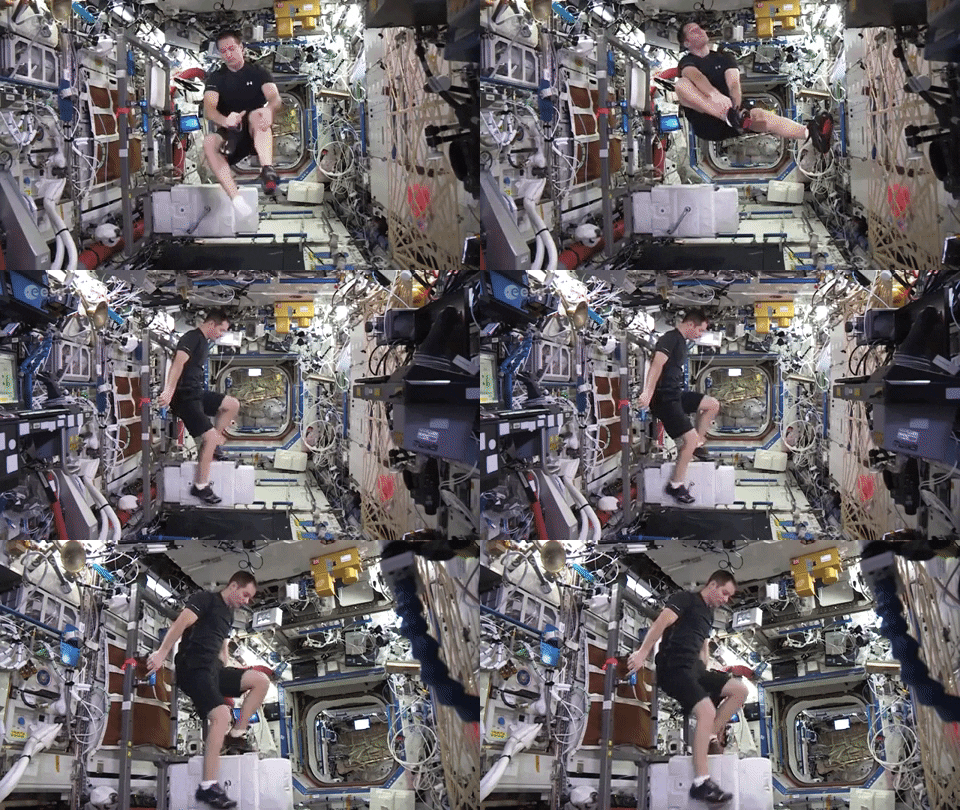
The Advanced Resistive Exercise Device (ARED) is the closest thing to a squat rack in low-Earth orbit. Rather than using weight plates (which would be useless in microgravity, a 45-lb plate weighs nothing in space), ARED uses vacuum cylinders to generate resistance across a full range of compound movements: squats, deadlifts, bench presses, overhead presses, heel raises, and more.
According to a PMC/NIH review of ISS exercise countermeasures, ARED comprises approximately 46% of total in-flight exercise time on long-duration missions, making it the primary workhorse for musculoskeletal preservation. Research from the ESA exercise countermeasures program confirms that intensive resistance exercise, imposing high loads on the musculoskeletal system for brief periods, is more effective than prolonged low-intensity activities for preserving both bone and muscle. The ARED is the closest thing astronauts have to ground-based strength training, and it is the cornerstone of the modern countermeasure strategy.
📊 Research note: An ESA PMC study found that even with ARED-based resistance training, up to 17% of astronauts may still experience loss of muscle performance, bone health, and cardiorespiratory fitness on current countermeasure protocols. This highlights the ongoing need to refine regimens and enhance pre-flight conditioning — the ARED is excellent, but space is still winning some rounds.
🏃 COLBERT: The Treadmill Named After a Comedian
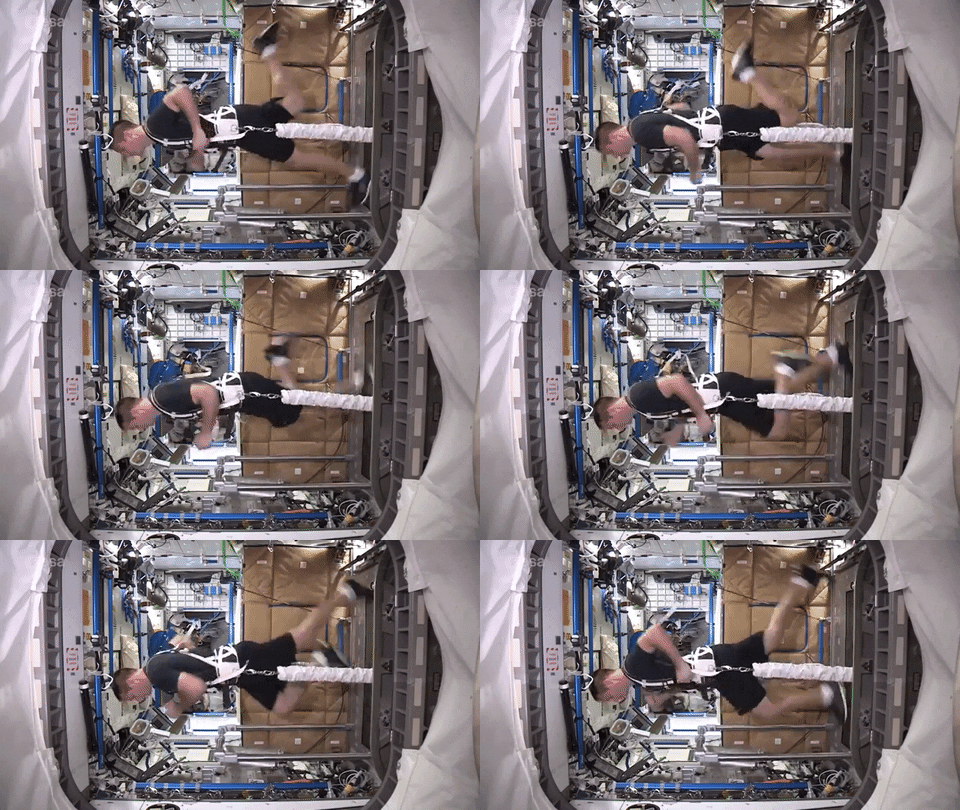
The Combined Operational Load-Bearing External Resistance Treadmill (COLBERT) is the ISS treadmill, and yes, it is genuinely named after TV personality Stephen Colbert. NASA held a public naming contest for the Tranquility module; Colbert used his show to encourage fan votes for the "Colbert" name. NASA declined to name the module after him but, in a diplomatic compromise, named the treadmill instead. The COLBERT provides motorized running speeds of up to 20.4 km/h (about 12.7 mph).
Since there is no gravity to keep a runner on the belt, astronauts wear a bungee harness system that pulls them downward against the treadmill surface, simulating ground reaction force. This is not comfortable, and it does not fully replicate the loading of terrestrial running; but it provides meaningful cardiovascular conditioning and lower-extremity bone stimulus, particularly important in the final weeks before re-entry, when ESA protocols shift focus heavily to treadmill running to prepare the body for Earth's gravity.
😄
Strapped to a treadmill by bungee cords, running in a harness while floating in microgravity, in a module named Tranquility. This is either the most surreal form of cardio ever devised, or exactly what a gym class in 2050 will look like. Possibly both.
🚴 CEVIS: Cycling Where No One Can Hear You Spin
The Cycle Ergometer with Vibration Isolation and Stabilization System (CEVIS) provides aerobic conditioning and cardiovascular workload between 25 and 350 Watts — a range that covers everything from a gentle recovery ride to a maximal sprint effort. CEVIS accounts for approximately 20% of in-flight exercise time, with primary emphasis on maintaining VO₂max (aerobic capacity) and cardiovascular health.
Research from PMC highlights that astronauts with higher VO₂peak levels are better equipped to work in heavy spacesuits, conduct extended extravehicular activities (spacewalks), and perform physically demanding exploration tasks. As missions to the Moon and Mars demand increasing physical self-sufficiency from crews, cardiovascular fitness becomes a mission-critical asset — not just a health metric.
📅 The Daily Schedule: A Workout You Cannot Skip
In practice, ISS astronauts follow a structured daily exercise prescription divided into distinct phases. During early mission phases, the emphasis is on building an in-flight fitness base. A mid-mission maintenance phase focuses on consistency. The final 3–4 weeks before re-entry — the "Preparation for Re-entry Phase" — shifts to maximally loading the body with ARED and treadmill work, preparing the musculoskeletal system for the shock of Earth's gravity after months of absence.
Exercises:
Squat and Deadlift (ARED)
Calf Raises (ARED)
Treatmill running on COLBERT
Cycle Ergometry (CEVIS)
Core and Posture Stability Workouts
The Inner Ear's Identity Crisis
Somewhere inside your skull, nestled in the temporal bone, sit two small fluid-filled structures called the otolith organs. Their job, which they have been doing reliably since before you could walk, is to detect gravity. They do this by sensing tiny calcium carbonate crystals (otoconia) that are displaced by the constant pull of the Earth — telling your brain, at all times and without conscious effort, which way is down.
In space, the otolith organs no longer detect a gravitational signal. This is profoundly disorienting, and a PubMed study confirms that roughly 70% of all astronauts experience impaired balance, locomotion, gaze control, and motion sickness within the first 3–4 days of both entering space and then again — crucially — after returning to Earth. The brain adapts to the absence of gravity, and then must un-adapt when gravity returns. It does not do this gracefully.
🧠 How the Brain Adapts (and Then Has to Un-Adapt)
Research published in PubMed (2022) used fMRI to measure brain activity in 15 astronauts before and after spaceflight, specifically while their vestibular systems were being stimulated. The findings revealed widespread reductions in somatosensory and visual cortical deactivation, meaning the brain had rewired itself to compensate for the loss of reliable vestibular input, leaning more heavily on visual and proprioceptive cues for spatial orientation.
These brain changes recovered to baseline values by 3 months post-flight. But in the immediate post-landing period, the mismatch between what the vestibular system is now reporting (gravity is back, everything is heavy and directional) and what the brain has spent months learning to expect creates a neurological conflict that manifests as staggering, disorientation, and difficulty with even routine balance tasks.
🧠
From PubMed (Paloski et al.): All 16 astronauts tested demonstrated decreased postural stability immediately upon return to Earth. The most dramatic increases in postural sway occurred when visual and proprioceptive feedback were simultaneously compromised. Meaning that returning astronauts in low-light conditions, or on uneven terrain, face compounded balance challenges in the early post-landing period.
🚶 The Aftermath: What Returning Astronauts Actually Experience
The classic image of an astronaut being carried out of a capsule on a stretcher is not purely ceremonial. Astronauts returning from long missions are genuinely unable to walk unassisted for the first hours after landing. Their legs feel impossibly heavy. The ground seems unstable. Their visual system, having been recalibrated to a weightless environment, is suddenly receiving information it no longer knows how to interpret with confidence.
🪑 Astronauts who have spent 6 months floating effortlessly through the ISS have reported that the act of simply sitting in a chair upon return feels like being pinned to the seat by an invisible, very rude person. The glass of water they're handed feels unreasonably heavy. Their own head weighs too much. Welcome back to Earth, please don't stand up too fast.
A separate PubMed study found that increased reliance on visual orientation cues, the brain's in-flight compensation strategy, actually worsened postural sway immediately after landing, not improved it. The visual system had been promoted to primary spatial orientation processor during the mission, and now it was receiving conflicting signals. The brain needed time to demote it back to its normal role and re-trust the vestibular system.
📅 The Post-Landing Timeline: Balance Recovery
Recovery from vestibular and musculoskeletal adaptation follows a rough timeline, documented across multiple PubMed and NASA studies:
Maximum Impairment: Balance & Gait
Days 1-4: All tested astronauts show decreased postural stability immediately post-landing. Astronauts cannot walk unassisted and require physical support. Inner ear recalibration begins.
Acute Vestibular Mismatch & Heavy Limb Syndrome
Days 4-8: Motion sickness, spatial disorientation, and extreme limb heaviness. Cardiovascular orthostatic intolerance peaks. Supervised physical therapy begins immediately.
Vestibular Recovery Phase
PubMed research confirms increased reliance on visual inputs disappears in most astronauts within 4–8 days. Independent walking returns. Balance in standard conditions normalizes.
Muscle Strength & Cardiovascular Reconditioning
Structured rehabilitation addresses muscle atrophy and cardiovascular deconditioning for 3-6 months. Exercise tolerance improves rapidly. Balance on challenging surfaces (uneven terrain, eyes closed) continues improving.
Brain Plasticity Reversal
fMRI studies show spaceflight-induced brain changes in vestibular processing recover to baseline by ~3 months. Most functional movement restored. Bone recovery continues for years.
Full Bone Density Recovery
NASA data indicates complete recovery of femoral bone density from a 6-month ISS mission typically requires 3–4 years of living in normal gravity. The last system to fully come home.
The Bottom Line: Space Is Worth It. Your Body Just Needs Convincing.
The human body in space is, despite its extraordinary adaptability, fundamentally a creature of Earth. Every system, skeletal, muscular, cardiovascular, vestibular, immune, has been shaped by millions of years of gravity, and it does not willingly let go of those assumptions. When you remove gravity, the body doesn't pause and wait. It starts remodeling itself immediately, efficiently, and in directions that are deeply inconvenient for anyone who plans to come back.
The extraordinary thing is how well the body does adapt, and how much of the damage can be mitigated through carefully designed exercise, nutrition, and pharmacological intervention. Two hours a day strapped to a vacuum-cylinder squat rack and bungee-harness treadmill, cycling furiously while floating in a tin can 408 km above the Earth and astronauts still come home walking (eventually) and recover to near-baseline health. That is, in its own way, a profound testament to human physiological resilience.
"These adaptations to weightlessness leave astronauts ill-equipped for life with gravity but they also demonstrate just how far we can push the boundaries of human physiology and bring people back from the edge of it."
As NASA's Artemis program targets the Moon and eventual crewed Mars missions, which could last two to three years, the stakes for solving these physiological challenges could not be higher. Future crews won't land near a recovery team. They won't have a hospital nearby. The countermeasures that get astronauts safely to Mars and back home will need to be better than anything we have today. The science is catching up. The body, as always, is doing its best.
⚠️Note: This article is for educational purposes only and is not a substitute for medical advice. All physiological claims are sourced from peer-reviewed literature via PubMed, PMC/NIH, and NASA research publications. For health concerns related to physical deconditioning, vestibular disorders, or bone health, consult a qualified healthcare professional.
References & Sources
Stein TP. Weight, muscle and bone loss during space flight: another perspective. PubMed. PMID: 23192310. PubMed ↗
Bikle DD, Halloran BP. Effects of spaceflight on the musculoskeletal system: NIH and NASA future directions. PubMed. PMID: 8462780. PubMed ↗
Orwoll E, et al. Bone mineral and lean tissue loss after long duration space flight. PubMed. PMID: 15758512. PubMed ↗
Cavanagh PR, et al. Prevention of bone loss and muscle atrophy during manned space flight. PubMed. PMID: 11541051. PubMed ↗
Diolaiuti F, et al. The Effect of Space Travel on Bone Metabolism. PMC/NIH. PMC8123809. PMC/NIH ↗
Scott JPR, et al. Effects of exercise countermeasures on multisystem function in long duration spaceflight astronauts. PMC/NIH. PMC9898566. PMC/NIH ↗
Green DA, et al. Exercise in space: the ESA approach to in-flight exercise countermeasures for long-duration missions on ISS. PMC/NIH. PMC4971634. PMC/NIH ↗
NASA. Astronaut Exercise.NASA.gov ↗
NASA. Counteracting Bone and Muscle Loss in Microgravity.NASA.gov ↗
NASA. Cardiovascular and Vision Laboratory.NASA.gov ↗
Stenger MB, et al. Spaceflight-Induced Intracranial Hypertension and Visual Impairment: Pathophysiology and Countermeasures. Physiol Rev. PubMed PMID: 29167331. PubMed ↗
Paloski WH, et al. Vestibular ataxia following shuttle flights: effects of microgravity on otolith-mediated sensorimotor control of posture. PubMed. PMID: 8424485. PubMed ↗
Wood SJ, et al. Brain and Behavioral Evidence for Reweighting of Vestibular Inputs with Long-Duration Spaceflight. PMC/NIH. PMID: 34416764. PMC/NIH ↗
Diedrich A, et al. Vestibular plasticity following orbital spaceflight: recovery from postflight postural instability. PubMed. PMID: 8749187. PubMed ↗
Lacour M, et al. Challenges to the Vestibular System in Space: How the Brain Responds and Adapts to Microgravity. PMC/NIH. PMC8595211. PMC/NIH ↗
Crucian BE, et al. Immune System Dysregulation During Spaceflight: Potential Countermeasures for Deep Space Exploration Missions. PubMed. PMID: 30018614. PubMed ↗
Mehta SK, et al. Multiple latent viruses reactivate in astronauts during space shuttle missions. PubMed. PubMed ↗
Mader TH, et al. Spaceflight-Induced Visual Impairment and Globe Deformations in Astronauts. PubMed. PMID: 29492564. PubMed ↗