
Whiplash After a Fender Bender: What Actually Happens to Your Spine
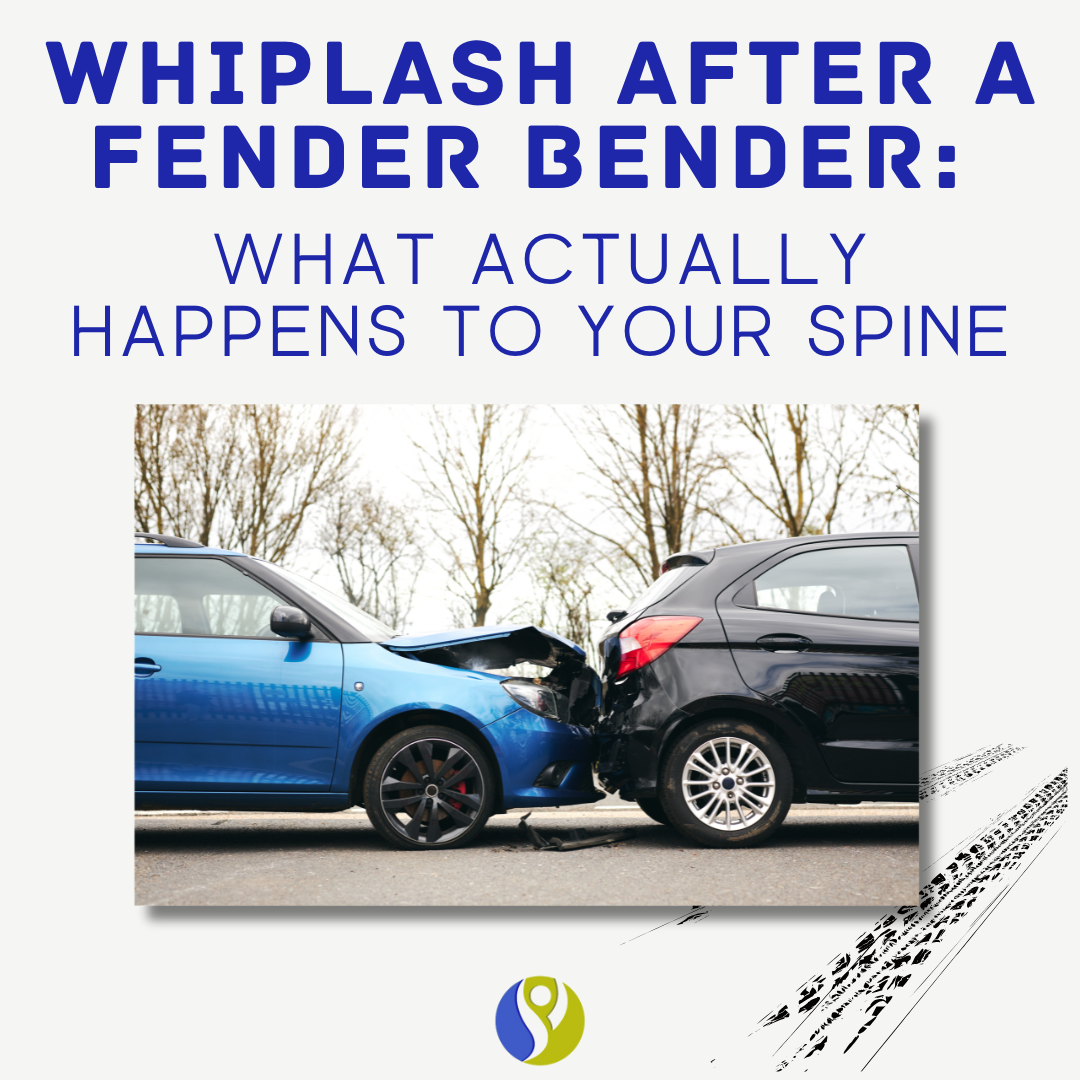
Somebody taps your bumper at 8 mph in a parking lot, and you feel completely fine. Then you wake up the next morning, and your neck has apparently filed for a restraining order against the rest of your body. Welcome to whiplash, a genuinely strange injury where the crash barely registers and the consequences absolutely do.

It's not just "your neck snapped back," it's weirder than that
The old mental image of whiplash, head snaps back, head snaps forward, done, undersells what's actually happening. Research on whiplash mechanics describes the cervical spine moving through a distinctive S-shaped curve during a rear-end collision: in the earliest fraction of a second, the lower part of the neck is forced into hyperextension while the upper part of the neck is simultaneously forced into flexion (the opposite motion) at the same time, in adjoining sections of the same structure. That's not how your neck is built to move under normal circumstances, which is exactly why low-speed impacts can cause outsized soft-tissue injury.
An editorial in a research collection on whiplash-associated disorder (WAD) notes that this "acceleration-deceleration mechanism" is the most common injury sustained in motor vehicle crashes, and occurs in the Western world at a rate of roughly 300 per 100,000 people every year.
Why the pain shows up late
The frustrating hallmark of whiplash (pain that doesn't peak until 24-72 hours later) comes down to what's actually getting damaged. Research on whiplash injury mechanisms describes several overlapping processes:
Ligament strain: particularly hyperextension injury to the anterior longitudinal ligament and the front of the cervical discs, tissues that are directly innervated and can independently generate pain.
Small joint injury: specifically to the cervical facet (zygapophysial) joints, research cited in clinical reviews notes these joints are at particular risk during whiplash-type collisions, and treating lesions there has shown a measurable positive effect on both pain and associated psychological symptoms.
Muscle compression effects: compression of the cervical spine during the initial phase of the collision has been shown to temporarily weaken the neck's ligaments, making them more vulnerable to the extension forces that follow milliseconds later.
None of that shows up as a visible bruise. It's connective tissue and small joint capsules getting strained in ways that don't always appear on standard imaging which is part of why whiplash has historically been dismissed by skeptics as "not a real injury." The biomechanics say otherwise.

The part that surprises people: it's not really about how big the crash was
Whiplash research consistently finds that injury severity doesn't track cleanly with how dramatic the collision looked. Studies simulating rear-end collisions at genuinely low speeds (as slow as 2.5 to 5 mph) using high-speed video and cineradiography have confirmed the same abnormal S-curve motion pattern of the cervical spine that occurs in more severe crashes. A "minor" fender bender can absolutely produce the same injury mechanism as a more dramatic-looking impact.
The long tail
Here's the sobering statistic: an editorial reviewing whiplash-associated disorder research found that approximately 50% of people who sustain a whiplash injury go on to develop chronic symptoms, and roughly 16% report ongoing severe, disabling pain. Part of what drives that chronic phase is a phenomenon called central sensitization, where the nervous system's pain-processing pathways essentially get turned up and stay turned up, amplifying pain signals well after the original tissue injury has started healing.
The takeaway
"I feel fine right after the accident" is not the same thing as "nothing happened." Given how whiplash mechanics actually work (small, deep structures getting strained in a motion your neck was never designed to make) a follow-up evaluation in the days after even a minor collision is a reasonable, evidence-backed move, not an overreaction.
Sources
Croft AC, et al. "Patient Mechanisms of Injury in Whiplash-Associated Disorders." Seminars in Spine Surgery, ScienceDirect.
"Editorial: Whiplash-associated disorder—advances in pathophysiology, patient assessment and clinical management." PMC, PMC9686416.
"Mechanisms of Whiplash Injury." Whiplash Injury and Chronic Pain: The Anatomy and Current Interdisciplinary Approaches to Management, eCampusOntario.
"Investigation of the Effect of Neck Muscle Active Force on Whiplash Injury of the Cervical Spine." PMC, PMC5904778.
Lord et al.; Yang et al.; Grauer et al., cervical spine injury mechanism research on whiplash kinematics and cineradiography studies of simulated low-speed collisions.