
Your hips and knees are not broken, they're just underprepared: a runner's guide to injury prevention on San Diego trails
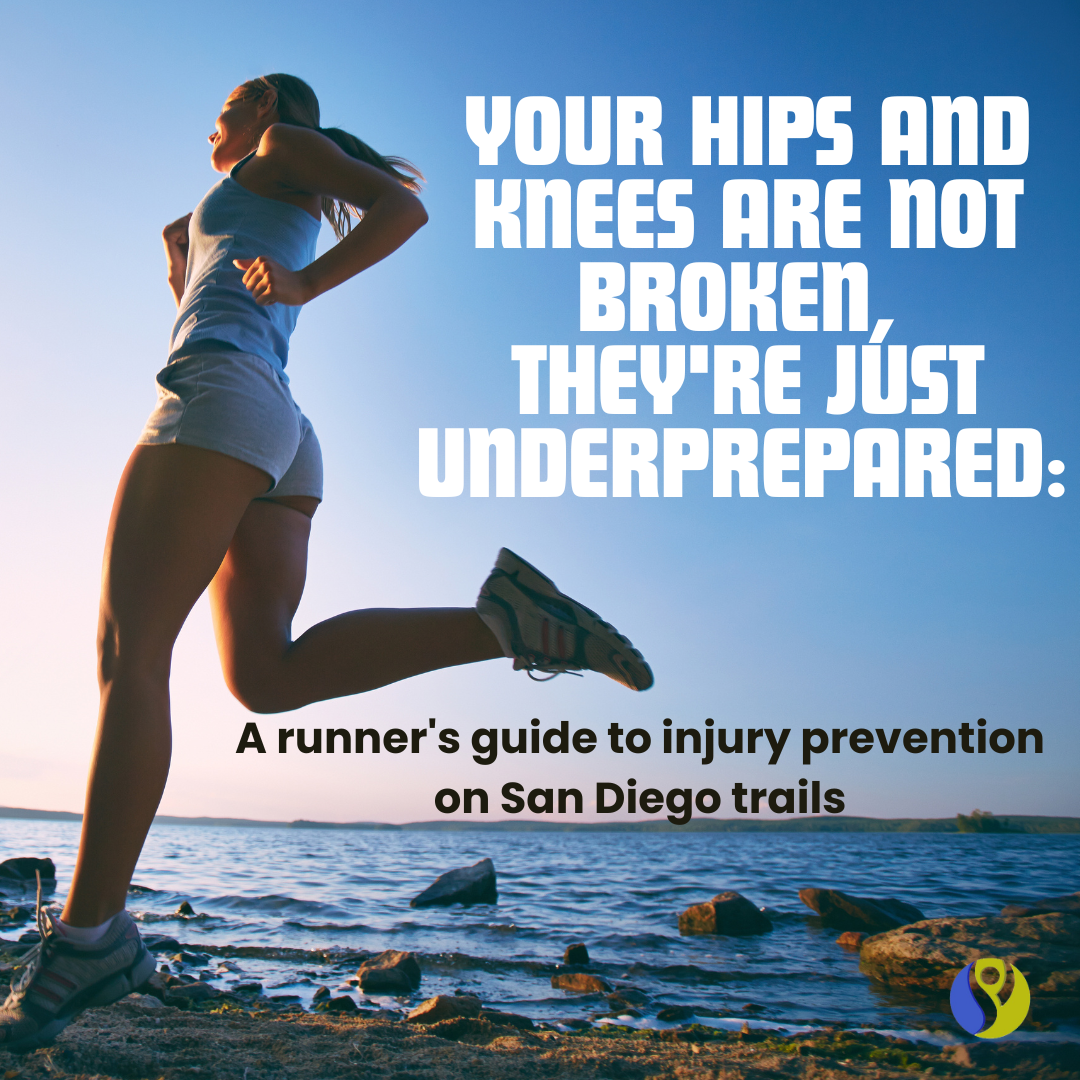
Evidence-based strategies for keeping your joints happy across every mile from Torrey Pines to Mission Trails — and yes, the research is more interesting than it sounds.
San Diego is a runner's city. The weather is almost offensively perfect, the trails are genuinely spectacular, and there's a 5K race somewhere in the county approximately every eleven days. It's wonderful. It is also, from a musculoskeletal perspective, a city full of people who are one bad training week away from learning what "patellofemoral pain syndrome" means from a medical professional while wearing compression shorts.
Running injuries are extraordinarily common — research suggests that somewhere between 37% and 79% of runners sustain an injury in any given year, with the knee and hip topping the list of casualties.[1] The remarkable thing about most of these injuries is that they are not random bad luck. They are predictable, and they are largely preventable. Here's what the science actually says.

The cadence conversation nobody is having at your running group
If there is one biomechanical change backed by the strongest recent evidence for reducing running-related hip and knee injuries, it is increasing your running cadence — the number of steps you take per minute. A 2025 systematic review published in Cureus (indexed on PubMed/NIH), following PRISMA guidelines and analyzing 18 studies, found that a moderate cadence increase of just 5–10% produced consistent and meaningful biomechanical benefits.[2]
"A moderate increase in cadence led to consistent biomechanical improvements, including reduced vertical ground reaction forces, lower loading rates, shorter stride length, and improved lower limb alignment. These adaptations were associated with reduced stress on the tibia, knee, and hip joints."[2]
In plain language: if you're running at 155 steps per minute and bump that up to 165–170, your knees absorb meaningfully less impact force per mile. The same review noted a reduction of approximately two degrees in dynamic knee valgus (that inward knee collapse you'll see in slow-motion injury videos) with a 10% cadence increase.[2] Two degrees sounds trivial. Across thousands of steps per run, it is not.
The conditions most linked to poor knee alignment — patellofemoral pain, iliotibial band syndrome, and medial tibial stress syndrome — all respond favorably to gait retraining that targets cadence and hip alignment. A 2024 study found that targeted gait retraining programs resulted in improved knee and hip alignment in runners with patellofemoral pain, with both biomechanical and pain outcomes improving meaningfully.[2]
Your glutes are probably not doing their job — and your knees are paying for it
The second major pillar of running injury prevention is hip and knee extensor strength. This is not a novel concept, but the research has gotten more specific and more useful in recent years. A cross-sectional study published in the Journal of Athletic Training examined 36 collegiate distance runners and found that greater squat strength was associated with significantly smaller peak knee internal-rotation angles — meaning stronger legs produced more stable, better-tracking knees under running load.[3]
Hip muscle weakness in particular has been linked to running-related injuries across multiple study designs. When the hip abductors and extensors are not doing their share of the work, the knee compensates — and not in a way that ends well. The gluteus medius, which stabilizes the pelvis during single-leg stance (which is, technically, all of running), is frequently underactive in injured runners.[3]
The practical upshot: two strength sessions per week targeting squats, lunges, single-leg deadlifts, and glute bridges are among the highest-return injury-prevention investments a runner can make. Not glamorous. Extremely effective.
Where chiropractic care fits in
Sports chiropractors are primary contact providers for running-related musculoskeletal injuries — meaning you don't need a referral, and you can come in while something is still a minor problem rather than a major one.[4] Chiropractic assessment of a runner's injury goes beyond the site of pain: we look at foot strike patterns, hip mobility, lumbar mechanics, and the full kinetic chain that connects your foot strike to your low back.
Manual therapy and spinal manipulation support neuromuscular function and can address joint restrictions that alter gait mechanics upstream of where you feel the pain. If your thoracic spine is stiff, for example, it affects how your arms swing, which affects your hip rotation, which affects your knee tracking. Everything is connected — which sounds like something you'd see on a motivational poster, but in this context is just anatomy.
Evidence-based checklist: running injury prevention in San Diego
Increase running cadence by 5–10% to reduce knee and hip joint loading[2]
Add hip extensor and abductor strengthening twice per week[3]
Follow the 10% rule — do not increase weekly mileage by more than 10% in a given week
Shorten your stride on Torrey Pines and Cowles Mountain descents — downhill running dramatically increases eccentric quad and knee load
Get a movement screen or chiropractic evaluation at the first sign of recurring pain — don't wait until you're limping
San Diego's trails deserve a body that can actually enjoy them. A little biomechanical attention now is a much better Saturday morning than icing your knee on the couch, watching other people run past your window.
References
Videbaek S, et al. Incidence of running-related injuries per 1000 h of running in different types of runners. Sports Med. 2015;45(7):1017–1026. PubMed
Figueiredo I, et al. The influence of running cadence on biomechanics and injury prevention: a systematic review. Cureus. 2025. DOI: 10.7759/cureus.90322. PMC / NIH
Dudley RI, et al. Association between knee- and hip-extensor strength and running-related injury biomechanics in collegiate distance runners. J Athl Train. 2021;56(4). PubMed
Mior S, et al. Opinions of sports clinical practice chiropractors about chiropractic research priorities in sports health care. J Can Chiropr Assoc. 2016. PMC / NIH