
Balance: Not Just an Aging Issue
Have you ever tripped over absolutely nothing, swayed while brushing your teeth, or felt unsteady stepping off a curb? Do you feel like it’s happening more often, like you’re extra clumsy? You may not just be clutsy, it could be your nervous system.
Balance is a full-time job for your nervous system, and it can get rusty at any age.
Balance Is Not a Muscle: It’s a Brain Skill
Balance doesn’t come from “strong ankles” alone. It comes from your brain’s ability to collect, interpret, and respond to sensory information in real time.
Your nervous system relies on three major input systems:
Visual Input
Your eyes constantly sending input to your brain. Some things your eyes tell your brain are:
Where you are in space
What’s moving (and what isn’t)
Whether the ground is doing something suspicious
If vision is limited, delayed, or overloaded, balance becomes harder immediately.
Vestibular System (Inner Ear)
Your vestibular system system detects:
Head position
Acceleration
Rotation
Gravity
It’s why turning your head quickly or scrolling your phone in the dark can make you feel off-balance. Your inner ear and eyes must agree. Oddly enough, they often argue.
Proprioception (The Unsung Hero)
Proprioception is your body’s internal GPS.
Proprioception comes from specialized nerve endings in:
Joints
Muscles
Ligaments
Fascia
These receptors constantly report:
Joint position
Speed of movement
Load and pressure
Your brain uses this information to answer one critical question: “Where is my body right now?”
Without accurate proprioceptive input, balance becomes guesswork.
How the Spine Fits Into All of This
The spine is loaded with proprioceptive receptors, especially in the neck and upper cervical region.
Why that matters:
The neck plays a major role in head position awareness
Head position directly affects vestibular and visual processing
Poor spinal motion = poor sensory information
When spinal joints are stiff, inflamed, or moving asymmetrically, the nervous system receives blurred or incomplete data.
And the brain does not like fuzzy information.
Why Balance Can Decline Long Before Old Age
Balance decline isn’t just about getting older, it’s about input quality. Common modern habits may disrupt your balance.
Sedentary Lifestyles
Less movement = fewer proprioceptive signals = weaker sensory maps in the brain.
Your nervous system is use-it-or-lose-it.
Chronic Neck and Back Pain
Pain alters how the brain processes sensory input.
Protective muscle tension and altered movement patterns distort proprioception.
The brain starts prioritizing safety over efficiency and balance suffers.
Previous Injuries
Old ankle sprains, knee injuries, concussions, or whiplash can permanently alter proprioceptive signaling if not fully rehabilitated.
The injury heals.
The nervous system adapts.
Sometimes poorly.
Poor Spinal Mobility & Posture
Slouched posture, limited spinal motion, and prolonged sitting reduce joint stimulation — meaning fewer accurate messages sent to the brain.
When joints don’t move well, the brain guesses.
Guessing is terrible for balance.
Balance Is a Nervous System Conversation
Balance isn’t just “standing still.”
It’s your brain rapidly integrating:
Sensory input
Motor planning
Reflexes
Postural control
This process happens thousands of times per second.
When any part of that loop breaks down: vision, vestibular input, proprioception, or spinal motion, balance becomes less reliable.
This is why someone can be young, strong, and still feel unsteady.
Chiropractic Care and Your Balance
Chiropractic care does not “give” you balance. It may help optimize the system that controls it.
Chiropractic care may support balance by:
Improving spinal and joint mobility
Enhancing proprioceptive input from joints
Reducing pain-related movement inhibition
Supporting postural awareness
Helping restore symmetrical movement patterns
When joints move more clearly, the nervous system receives clearer information and balance improves as a downstream effect.
This is about neurological clarity, not age.
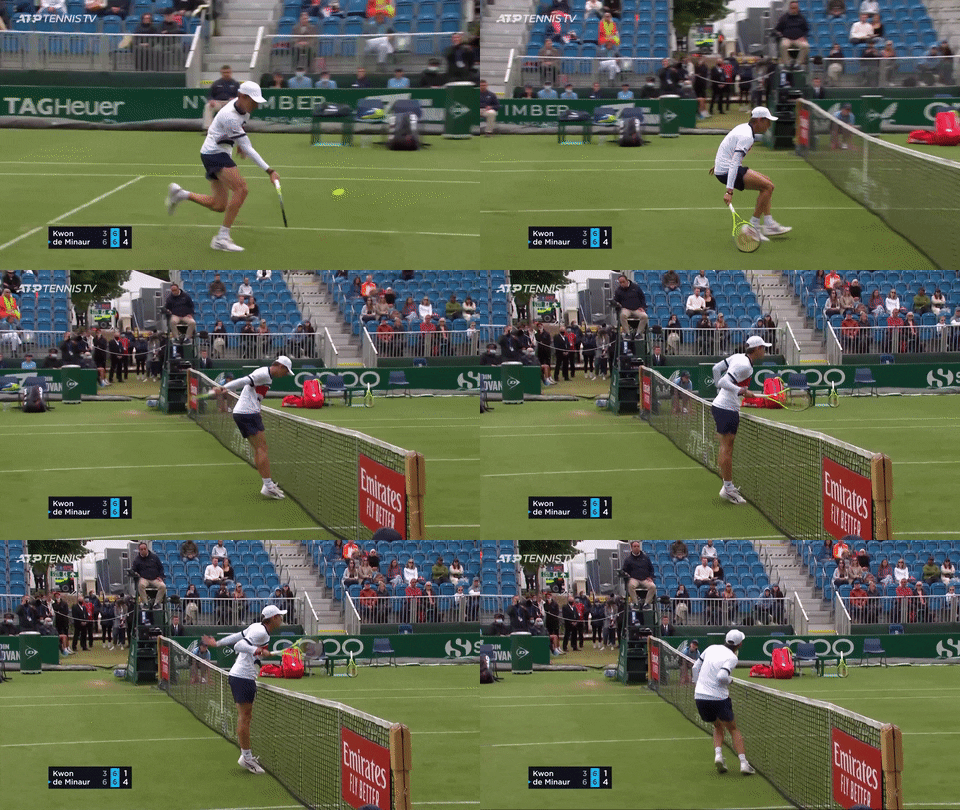
Why Balance Training Isn’t Just for Fall Prevention
Better balance means:
More efficient movement
Faster reaction times
Lower injury risk
Improved confidence with activity
Your nervous system doesn’t care how old you are. It cares how well it can interpret your body.
Bottom Line
Balance is not an age issue. It’s a sensory input and nervous system integration issue.
If your joints aren’t moving well, your posture is locked up, or your nervous system is getting fuzzy information — balance will reflect that.
Your balance system doesn’t care about birthdays.
It cares about how clearly your brain understands your body.
References
Horak FB. Postural orientation and equilibrium: What do we need to know about neural control of balance? Physical Therapy.
Johns Hopkins Medicine. Balance Disorders.
Proske U, Gandevia SC. The proprioceptive senses: Their roles in signaling body shape, body position and movement. Physiological Reviews.
PubMed. Spinal proprioception and postural control.