
🥎⚾ The Throwdown: Softball vs. Baseball Mechanics Explained
Same physics, different mechanics
If you’ve ever watched a baseball pitcher and a softball pitcher side‑by‑side, you’ve probably wondered whether they’re playing the same sport or reenacting two different chapters of human evolution. One looks like he’s trying to hurl a thunderbolt. The other looks like she’s winding up a trebuchet powered by spite and quad strength.
But beneath the comedy, there’s real science — and a lot of it.

⚾ Baseball Pitching: The Overhand Torque Machine
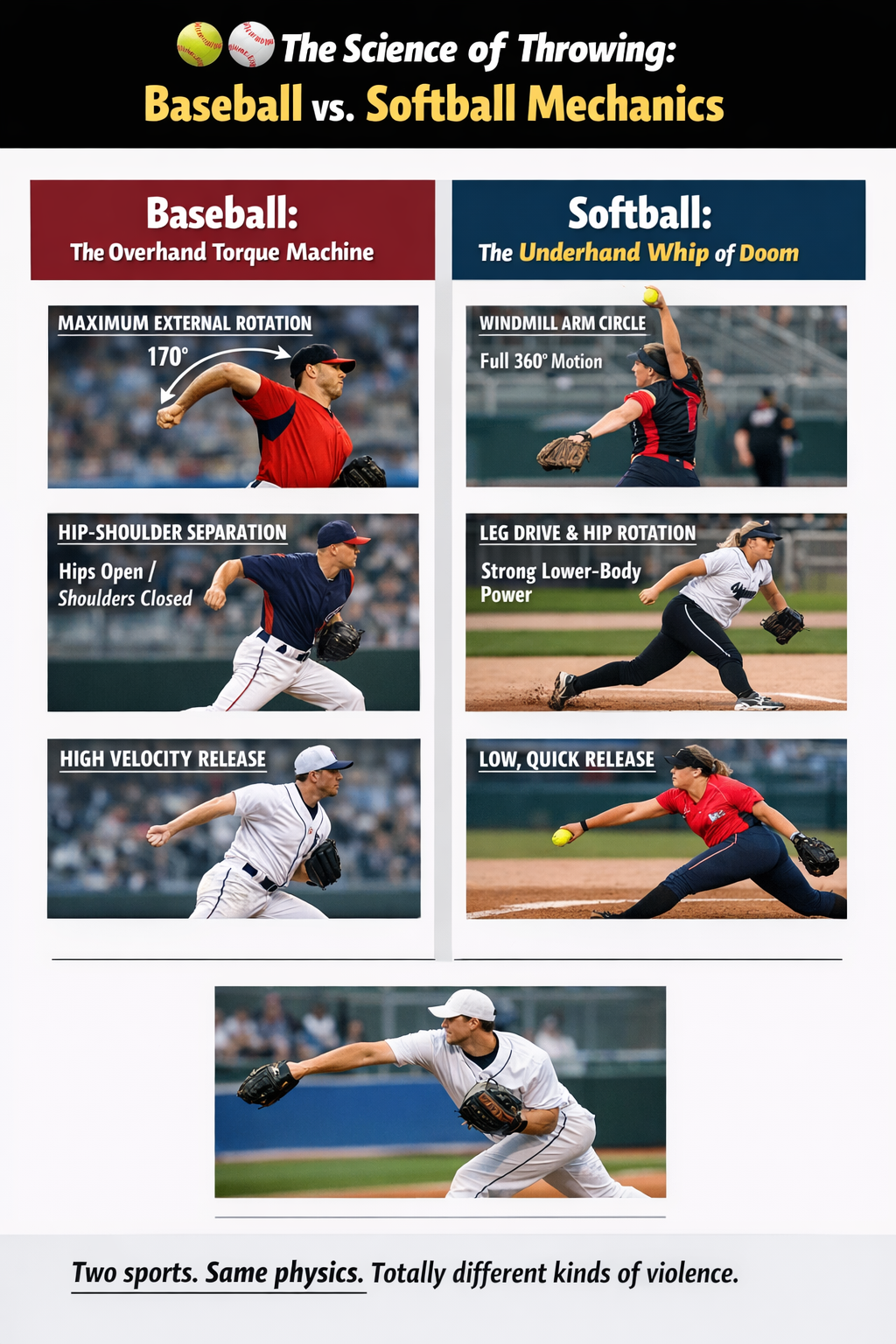
Baseball pitching is a high‑velocity, high‑stress, externally rotated movement. Elite pitchers reach around 170° of shoulder external rotation, producing enormous valgus stress on the elbow and relying heavily on hip‑shoulder separation to generate velocity.
Biomechanical Highlights:
Extreme shoulder external rotation (~170°)
High elbow torque (~64 Nm)
Hip‑shoulder separation drives velocity
Translation: Baseball pitchers twist themselves like a human pretzel and pray their elbow doesn’t quit mid‑season.
Picture Breakdown:
Wind‑Up – relaxed posture, leg lift, balance.
Max External Rotation – arm cocked back, shoulder at ~170°.
Acceleration – torso rotation and arm whip forward.
Release – hip‑shoulder separation visible, ball exits hand.

🥎 Softball Pitching: The Underhand Whip
Softball pitching is cyclic, whip‑like, and surprisingly joint‑friendly. The windmill motion keeps the shoulder in a neutral plane, reducing injury risk while still generating elite velocity.
Biomechanical Highlights:
Lower shoulder torque than baseball
Angular velocities exceeding 5,000°/s
Neutral shoulder plane = fewer injuries
Translation: Softball pitchers generate elite velocity using a motion so efficient they can throw 150 pitches in a weekend tournament and still have energy to yell “LET’S GO!”
Picture Breakdown:
Windmill Motion – full arm circle, shoulder neutral.
Kinetic Chain – leg drive and hip rotation power the motion.
Release Point – low, forward release with wrist snap.
Follow‑Through – balanced finish, ready for fielding.
🧬 Why Softball Mechanics Align Well With Many Female Athletes
This is about anthropometrics, not stereotypes.
🥎 Lower‑Body Dominance = Softball Gold
Research shows women, on average, have:
Greater hip internal rotation (Ferber et al., 2003)
Higher quadriceps activation (Jacobs et al., 2007)
Lower center of mass (Winter, 2009)
These traits support:
Explosive leg drive
Stable rotational mechanics
Efficient force transfer

🥎 Underhand Motion Reduces Upper‑Body Stress
Softball pitching:
Minimizes shoulder torque
Uses a full‑body kinetic chain
Rewards timing over brute force
This aligns well with the average female strength distribution (greater lower‑body vs. upper‑body strength).
🥎 The Sport’s Design Complements These Mechanics
Softball’s:
Larger ball
Shorter pitching distance
Flat circle
…all reward mechanics many female athletes naturally excel at.
🧬 Why Baseball Throwing Often Aligns With Many Male Athletes
⚾ Longer Levers = More Overhand Velocity
Men, on average, have:
Longer limb segments
Greater upper‑body muscle mass
Higher absolute external rotation strength (Kubo et al., 2003)
These traits enhance:
Hip‑shoulder separation
Overhand torque
Ball velocity
⚾ Baseball Rewards Upper‑Body Power
The overhand pitch relies heavily on:
Rotator cuff strength
Scapular control
Trunk rotational power
Areas where men typically have higher absolute strength due to hormonal and musculoskeletal differences.

⚾ The Environment Amplifies These Traits
The mound, distance, and ball weight all reward:
Long levers
High rotational velocity
Explosive upper‑body output
Baseball pitchers look like:
They’re trying to throw their arm so hard it enters another tax bracket.
They’re reenacting a slow‑motion car crash.
They’re summoning ancient gods for velocity.
Softball pitchers look like:
They’re winding up a trebuchet.
They’re conducting an orchestra made entirely of pain.
They’re about to lasso a cow and then strike you out.
Biomechanics is beautiful. Biomechanics is also hilarious.
📚 Peer‑Reviewed Sources
Aguinaldo & Chambers (2009). Throwing mechanics and elbow valgus load.
Barrentine et al. (1998). Biomechanics of the windmill softball pitch.
Ferber et al. (2003). Gender differences in lower extremity mechanics.
Fleisig et al. (1995). Kinetics of baseball pitching.
Jacobs et al. (2007). Sex differences in muscle activation.
Kubo et al. (2003). Sex differences in muscle/tendon properties.
Maffet et al. (1995). Shoulder stress in underhand vs. overhand throwing.
Oliver & Plummer (2010). Kinematics of the windmill pitch.
Stodden et al. (2001). Hip‑shoulder separation and throwing velocity.
Winter (2009). Biomechanics and Motor Control of Human Movement.